
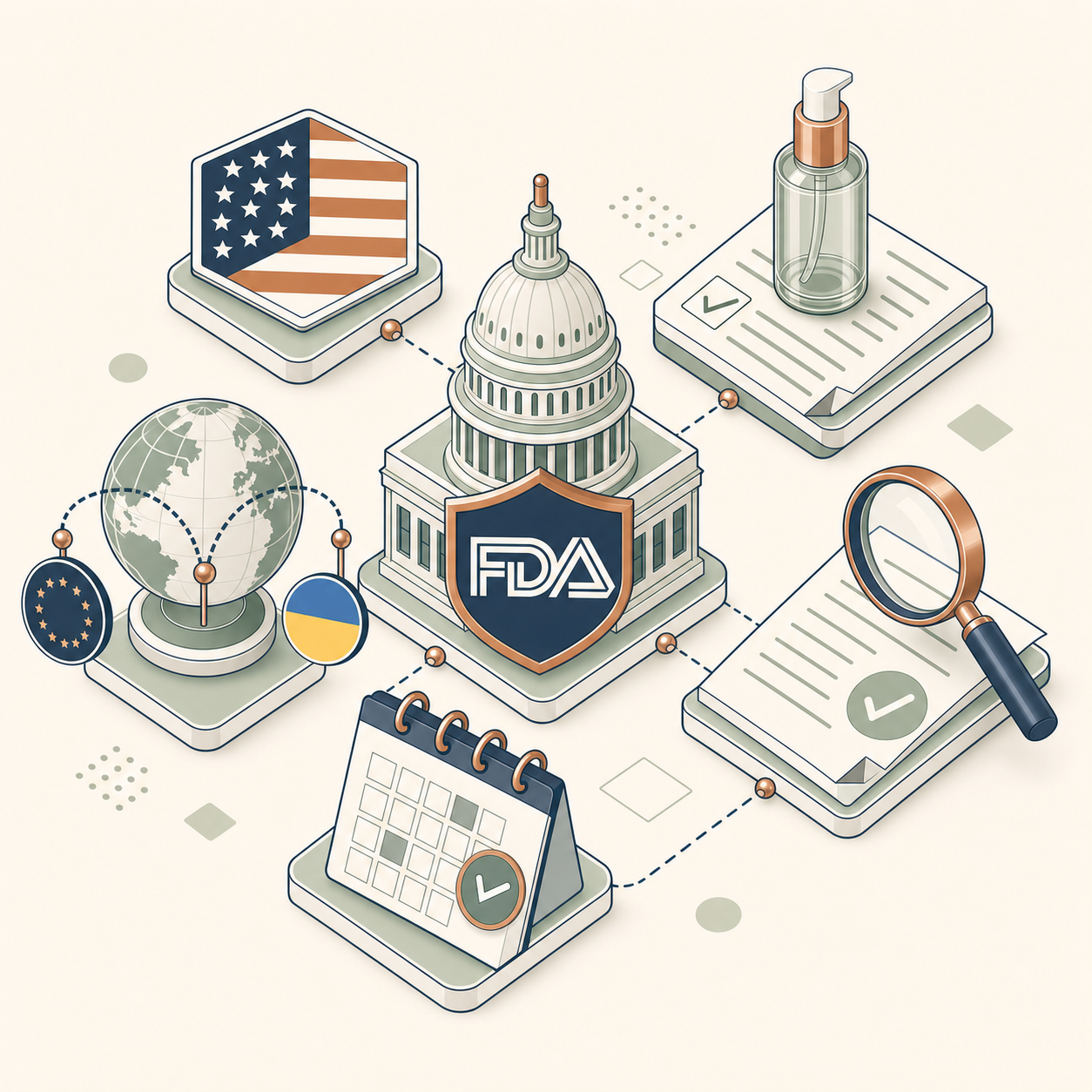
# MoCRA for Ukrainian and European cosmetics manufacturers: what you need to do in 2026
If you sell cosmetics in the United States or plan to, MoCRA already applies to you. Whether your manufacturing is located in Kharkiv, Warsaw or Milan, the US regulator FDA expects you to register, report and comply with the new rules.
> MoCRA in two words: the Modernization of Cosmetics Regulation Act of 2022 (MoCRA) is the first major update of US cosmetics legislation since 1938. It obliges every manufacturer that supplies products to the US market to register manufacturing facilities, submit product listings and report serious adverse events.
---
1. What MoCRA is and why it matters to non-US manufacturers
MoCRA (Modernization of Cosmetics Regulation Act of 2022) was signed on 29 December 2022 as part of the Consolidated Appropriations Act, 2023. Until that point, US cosmetics legislation had effectively been unchanged since 1938: FDA had no authority to issue mandatory recalls, demand documentation or inspect manufacturer records. MoCRA changed all of that ([FDA.gov](https://www.fda.gov/cosmetics/cosmetics-laws-regulations/modernization-cosmetics-regulation-act-2022-mocra)).
A key mistake EU and UA manufacturers make is treating MoCRA as an "American" problem. In fact, the Act applies to any manufacturer supplying products to the US market, regardless of where production is physically located.
Two principal mechanisms are already active: - Facility registration — enforcement began on 1 July 2024 - Adverse event reporting — in effect from 29 December 2023, with no transitional period
The GMP rules and the fragrance allergen rule are still awaiting finalisation (more on this below), but ignoring the requirements that are already in force means knowingly accepting regulatory risk on the US market.
---
2. Who must register: definitions of manufacturer and responsible person
MoCRA introduces two key concepts that differ from their counterparts in EU Regulation 1223/2009.
Manufacturer under MoCRA is a person (legal or natural) that manufactures or processes cosmetics. The term "facility" covers any premises where cosmetic products supplied to the US market are manufactured or processed, including facilities located outside the United States.
Foreign facility is a facility located outside the United States that produces cosmetics for the US market. Such a facility is subject to facility registration on the same basis as a US one ([FDA.gov](https://www.fda.gov/cosmetics/registration-listing-cosmetic-product-facilities-and-products)).
Responsible Person under MoCRA is the manufacturer or US legal entity that assumes responsibility for the safety and compliance of the product with US standards. This is not the same as the EU Responsible Person under Regulation 1223/2009:
| Parameter | MoCRA Responsible Person | EU Responsible Person (1223/2009) | |---|---|---| | Location | May be inside or outside the US | Must be established in the EU | | Core duties | Product listing, AER, safety records | CPNP, PIF, CPSR, cosmetovigilance | | Who submits | RP or manufacturer | EU RP only | | Counterpart | US Agent / US Importer | EU RP / Importer |
For a foreign manufacturer that does not have a US office, the Responsible Person role is typically performed by a US distributor or a specialised US Agent. The absence of such a person does not relieve a manufacturer of its obligations — on the contrary, it means that the manufacturer bears direct responsibility itself.
Important exception. Small businesses with average annual gross receipts of less than $1,000,000 over the previous three years are not subject to facility registration. However, this exemption does not apply to products that come into contact with the mucous membrane of the eye, are injected, are intended for internal use or alter appearance for more than 24 hours ([SRC Consultants](https://srcconsultants.com/news/reminder-to-file-cosmetic-product-listings-and-facility-registrations-by-july-1st/)).
---
3. The two-step process: facility registration and product listing
The MoCRA compliance framework is built on two parallel processes that run through the [FDA Cosmetics Direct portal](https://direct.fda.gov/).
### 3.1 Facility registration
Facility registration is the registration with FDA of every manufacturing facility where cosmetics for the US market are manufactured or processed.
| Requirement | Deadline | |---|---| | Initial registration (for existing facilities) | Enforcement from 1 July 2024 | | New facilities (operating after 29 December 2022) | Within 60 days of start of manufacture | | Biennial renewal | Every 2 years from the initial registration date | | Changes to information | Within 60 days of the change |
What must be provided at registration: - Name and address of the facility (for foreign facilities, the full overseas address) - Type of manufacturing activity (manufacturing, processing, packaging, storage) - Contact information, including the US Agent for foreign facilities - FEI number (if already assigned by FDA)
From February 2026, FDA Cosmetics Direct displays REGISTRATION STATUS and RENEWAL DATE fields to make it easier to track renewal deadlines ([FDA.gov](https://www.fda.gov/cosmetics/registration-listing-cosmetic-product-facilities-and-products)).
In practical terms for a UA/EU manufacturer. If your factory in Ukraine or any EU country supplies products to the United States, it is a "foreign facility" and is subject to registration. There is no opt-out: this is not a voluntary procedure. Registration is free of charge (approximately $0 until 2027).
### 3.2 Product listing
Product listing is a separate process in which the Responsible Person submits to FDA a list of every cosmetic product sold on the US market. Facility registration and product listing are two distinct records in the Cosmetics Direct system.
| Requirement | Details | |---|---| | Initial listing (for products on sale before 29 December 2022) | Enforcement from 1 July 2024 | | New products | Within 120 days of the start of marketing | | Annual update | Mandatory each year | | Listing fee | Free of charge (approximately $0 until 2027) |
What product listing covers: - Full product name and brand - Product category and type - Name and address of the manufacturing facility - A full list of ingredients (in accordance with the INCI system) - A copy or image of the product label - A declaration that the product complies with safety requirements
Note: product listing is the Responsible Person's duty, not the manufacturer's. If a single manufacturer supplies OEM products to several US brands, each brand files its own listing for its SKUs.
---
4. Adverse Event Reporting (AER): the 15 business-day rule
Adverse event reporting (AER) is one of the most "live" MoCRA requirements, as it has been in force from 29 December 2023 with no transitional period.
What is a Serious Adverse Event (SAE)? Any adverse reaction to the use of a cosmetic that results in: - Hospitalisation - A life-threatening condition - Significant disfigurement - Infection - Disability or incapacity - Death
The 15 business-day rule. The Responsible Person must submit a report to FDA within 15 business days of becoming aware of an SAE ([Axentra Compliance](https://www.axentracompliance.com/post/mocra-adverse-event-reporting-guide)). The report is accompanied by a copy of the product label.
Within 1 year of the initial report, any new information that has come to light in the case must also be submitted.
Record keeping. All adverse event records (including minor ones not subject to mandatory reporting) must be kept for 6 years (3 years for small businesses).
Labelling requirement. Every cosmetic product sold on the US market must bear contact information (a US address, phone number or email) for receiving consumer reports. This requirement has been in force since 29 December 2023.
Public SAE register. On 12 September 2025 FDA launched the FAERS Public Dashboard for Cosmetic Products ([Obelis US](https://www.obelis.us/2025/10/fda-cosmetic-product-issues/)), a database of serious adverse events that is updated daily. Any competitor can check your brand.
Practical takeaway. UA and EU manufacturers that supply the US through a distributor need to: 1. Agree a mechanism for passing SAE information from the distributor to the RP 2. Appoint an internal person responsible for maintaining the adverse event register 3. Make sure the labelling contains a US contact element
Minor complaints — scratches, dissatisfaction with fragrance, an allergic rash without hospitalisation — do not require an FDA report, but must be recorded internally.
---
5. PFAS bans in cosmetics: 14 states, federal action on the horizon
PFAS (per- and polyfluoroalkyl substances) are a group of synthetic compounds used in cosmetics as water-repellent agents, pigment dispersants and film formers. There is as yet no federal ban on PFAS in cosmetics in the United States, but 14 states have already introduced their own bans on intentionally added PFAS.
| State | Effective date | Legislative act | |---|---|---| | California | 1 January 2025 | AB 2771 (PFAS-Free Cosmetics Act) | | Colorado | 1 January 2025 | HB 22-1345 | | Maryland | 1 January 2025 | HB 643 | | Minnesota | 1 January 2025 | HF 2310 (Amara's Law) | | Washington | 1 January 2025 | HB/SB 1047 | | Maine | 1 January 2026 | LD 1537 | | Vermont | 1 January 2026 | SB 25 | | Connecticut | 1 July 2026 (notification) → 1 January 2028 (full ban) | SB 292 | | New Hampshire | 1 January 2027 | HB 1649 | | Oregon | 1 January 2027 | SB 546 | | New Jersey | 1 January 2028 | SB 1042 | | New Mexico | 1 January 2028 | HB 212 | | Rhode Island | 1 January 2029 | SB 2152/HB 7356 | | Illinois | 1 January 2032 | HB 2516 |
On 29 December 2025 FDA published its safety assessment of PFAS in cosmetics under the MoCRA mandate ([Morgan Lewis](https://www.morganlewis.com/pubs/2025/12/state-pfas-bans-in-cosmetics-expand-ahead-of-2026)), which may serve as the basis for a future federal ban.
In practical terms. If your product contains any fluorinated compound (look in the INCI list and supplier specifications for any name containing "fluoro", "perfluoro", "polytetrafluoroethylene" or PTFE), you will need to reformulate in order to sell in states where the ban is already in force. California is the largest market where the ban has been active since 1 January 2025. Brands selling nationwide must exclude PFAS from all US formulas ([Compliance & Risks](https://www.complianceandrisks.com/blog/pfas-in-cosmetics-us-state-bans-and-compliance-deadlines-2026-update/)).
---
6. Talc and fragrance allergen rules: current status
### Talc/asbestos rule — withdrawn in November 2025
MoCRA Section 3505 required FDA to develop standardised requirements for testing talc for asbestos. The proposed rule was issued on 27 December 2024 but was withdrawn by FDA on 28 November 2025 ([FDA.gov](https://www.fda.gov/cosmetics/cosmetic-ingredients/talc)) on technical grounds: the TEM method was producing false-positive results for non-asbestiform amphibole particles. No new publication date for a replacement rule has been announced.
An important piece of context, however: the EU has already classified talc as a carcinogen and plans to ban it in cosmetics by 2027. UA and EU manufacturers selling into both markets should already be planning to phase talc out of their formulas regardless of the uncertainty in the United States.
### Fragrance allergen rule — postponed to May 2026
MoCRA Section 609(b) required FDA to identify fragrance allergens and to require their individual disclosure on labels. The original deadline of June 2024 was missed. The revised deadline of January 2025 was also missed. The current expected publication date for the proposed rule is May 2026, but as of June 2026 the rule has still not been published ([Crowell & Moring](https://www.crowell.com/en/insights/client-alerts/cosmetics-under-the-microscope-fdas-expanding-regulatory-reach-under-mocra)).
The practical takeaway: the EU standard of 82 allergens, which is already required in the EU from 31 July 2026, is significantly stricter than any conceivable US rule on the horizon. Brands that have met the EU allergen requirement will have a significant head start when FDA finally issues its own rule.
---
7. What MoCRA means for a Ukrainian manufacturer exporting to the US
The situation depends on the route to market in the United States.
### 7.1 Through a US distributor
This is the most common scenario for a UA manufacturer at an early stage. The US distributor will typically take on the role of Responsible Person and submit product listings in its own name.
However, your factory in Ukraine remains a "foreign facility" and needs its own facility registration in FDA Cosmetics Direct. The distributor cannot register your facility on your behalf — registration is carried out directly by the operator of the facility.
What you need to do: 1. Register the manufacturing facility in FDA Cosmetics Direct 2. Appoint a US Agent (a contact person or company based in the United States for communication with FDA) 3. Sign an agreement with the distributor setting out the AER mechanism: who notifies the RP of an SAE and within what timeframe 4. Make sure the product labelling contains US contact information
### 7.2 Through a US brand (OEM/white label)
Where a UA manufacturer produces under a US brand owner's name, the structure is similar: facility registration remains the manufacturer's duty, while product listing is the duty of the brand owner (US Responsible Person). It is important to spell out in the contract responsibility for providing complete information for listing and for exchanging data on SAEs.
### 7.3 Direct sales (direct-to-consumer, e-commerce)
Where a UA brand sells directly to US consumers via its own website, Shopify, Amazon or similar channels, the brand is itself the Responsible Person and bears all the obligations: facility registration, product listing and AER. A US address on the label for receiving SAE reports is mandatory.
### 7.4 Safety documentation (safety substantiation)
MoCRA requires "adequate substantiation" of the safety of every cosmetic product. FDA has not yet finalised specific format requirements, but records must be maintained and be available for inspection.
An important question for UA/EU manufacturers: does an EU CPSR count for MoCRA purposes? The short answer is yes, with caveats. An EU CPSR drawn up in line with the SCCS 12th revision guidelines covers most of the substantive aspects of MoCRA safety substantiation — ingredient safety assessment, toxicological data, exposure assessment. However, an EU CPSR does not replace MoCRA product listing and does not exempt you from facility registration. It is recommended to keep the EU CPSR as part of the safety substantiation file with a note on its alignment with MoCRA.
---
8. What MoCRA means for an EU manufacturer with a US subsidiary or distributor
An EU manufacturer with a US affiliate or an exclusive US distributor faces a somewhat different set of questions.
Where the US subsidiary is the Responsible Person. All duties (product listing, AER, safety records) sit with the US legal entity. The EU factory still needs its own facility registration. The EU manufacturer and the US RP must have an agreement in place covering the exchange of all technical data needed for product listing and the response to SAEs.
Where the EU parent company is the Responsible Person. This is possible, but it requires a US address for receiving official correspondence from FDA and for use on labelling. In practice, EU manufacturers in this scenario appoint a US Agent.
Synchronising EU and MoCRA compliance. The EU and US systems share a structural similarity that can be used to optimise costs:
| Requirement | EU (1223/2009) | MoCRA (US) | Synergy | |---|---|---|---| | Product registration | CPNP notification | Product listing | Ingredient list is shared — a single INCI file | | Product safety | CPSR (Annex I) | Safety substantiation | EU CPSR can serve as the basis for MoCRA | | Issue reporting | SAE → EU national authority | SAE → FDA (15 days) | One internal register, two reports | | GMP | EN ISO 22716 | Pending MoCRA rule (based on ISO 22716) | One audit covers both markets | | Responsible person | EU RP (in the EU) | US RP / US Agent (in the US) | Two separate appointments |
EU manufacturers that already have a full EU compliance system (CPSR, CPNP, ISO 22716) are in a significantly better position for MoCRA than manufacturers starting from scratch. The main additions required are: facility registration, product listing through Cosmetics Direct and AER procedures.
---
9. Comparison table: MoCRA vs EU CPSR vs UA TR
| Parameter | MoCRA (US) | EU Reg. 1223/2009 | UA Technical Regulation (CMU Resolution No. 65) | |---|---|---|---| | Facility registration | Yes, facility registration (every 2 years) | No (CPNP only for products) | No (but e-notification of products) | | Product notification | Product listing (Cosmetics Direct) | CPNP notification (cpnp.ec.europa.eu) | E-notification (MoH portal) | | Safety documentation | Safety substantiation (format not finalised) | CPSR Part A + Part B (Annex I) | CPSR (analogous to EU) | | Who signs the CPSR | Not regulated | Qualified safety assessor (EU) | Qualified specialist (UA) | | AER (serious reactions) | 15 business days → FDA | No fixed deadline → national authority | Required (timeframes in development) | | GMP standard | ISO 22716 (final rule pending) | EN ISO 22716:2007 | DSTU EN ISO 22716:2015 | | PFAS ban | 14 states (federal pending) | In packaging from 12 August 2026 (PPWR) | No specific provision | | Responsible person | US Responsible Person / US Agent | EU Responsible Person (in the EU) | UA Responsible Person (resident of Ukraine) | | Registration cost | ≈ $0 (free until 2027) | ≈ $0 (CPNP free of charge) | ≈ $0 (e-notification free of charge) | | Language of documents | English | Language(s) of the Member State(s) + EN | Ukrainian + EN (translation required) |
---
10. A step-by-step plan: from facility to compliance in 30 days
The practical plan below is for a UA or EU manufacturer entering the US market for the first time, or bringing existing operations into line with MoCRA.
Week 1 — Preparation and appointments. Identify the Responsible Person (US distributor, US subsidiary or US Agent). Appoint a US Agent for communication with FDA. Gather data on all manufacturing facilities (name, address, type of activity) and the INCI ingredient list for each SKU. Check that labelling includes US contact information.
Week 2 — Facility registration. Visit the [FDA Cosmetics Direct portal](https://direct.fda.gov/). Create an account and complete the registration form for each facility. Obtain an FEI number and record the registration date — the 2-year renewal cycle is counted from there.
Week 3 — Product listing. Through the Responsible Person's account, submit a product listing for each SKU: INCI list, label image and category. For new products, set an internal deadline of no later than 120 days after the start of US marketing.
Week 4 — AER procedure. Approve an internal SOP for receiving and processing adverse event reports. Set out in the distributor agreement an obligation to pass on SAE information immediately. Identify the person responsible for meeting the 15-day deadline. Set up a record-keeping system (minimum 6 years).
After 30 days — ongoing compliance. Annual updates of product listings, renewal of facility registration every 2 years, monitoring of PFAS legislation in further states, and tracking of the FDA Unified Agenda for the fragrance allergen rule and the GMP final rule.
---
FAQ: frequently asked questions from UA and EU manufacturers
Is facility registration required if we only sell into the US through Amazon?
Yes. The sales channel is irrelevant. If your factory manufactures a product that is sold on the US market — whether through Amazon, Shopify, wholesale or retail — it is subject to facility registration as a foreign facility.
Who can act as US Agent for a foreign manufacturer?
The US Agent is a person or company that has a physical address in the United States and serves as the official point of contact for FDA. This can be a distributor, a law firm, a specialised regulatory agent or any US company that agrees to take on the role. The US Agent is not automatically the Responsible Person — these are separate roles.
Can an EU CPSR fully replace MoCRA safety substantiation?
An EU CPSR drawn up in line with the current SCCS 12th revision guidelines covers most of the substantive requirements of MoCRA safety substantiation. However, it does not replace facility registration or product listing. It is recommended to keep the EU CPSR as part of the safety substantiation documentation, with a separate note on its alignment with MoCRA.
Are GMP requirements already mandatory?
No. FDA proposed a GMP rule in December 2024, but the final rule has been moved to "Long-Term Action" status with no set publication date ([Crowell & Moring](https://www.crowell.com/en/insights/client-alerts/cosmetics-under-the-microscope-fdas-expanding-regulatory-reach-under-mocra)). However, EU ISO 22716 GMP certification is effective preparation: when the US GMP rule is finalised, it will be built on the same ISO 22716 foundation.
What happens if an SAE occurs in the United States but the Responsible Person is in Europe?
The 15-day deadline is counted from the moment the Responsible Person (or any person acting on its behalf) receives the information. The physical location of the RP is irrelevant. This is exactly why it is critical to have a well-organised process between the US distributor and the manufacturer for the immediate exchange of SAE information.
Does the MoCRA small business exemption ($1M) apply to an EU company?
Yes. The small business exemption is tied to sales volume, not geography. If a company's average gross receipts from cosmetics sales in the United States over the past three years are below $1,000,000, it is exempt from AER reporting (but not from facility registration or product listing). Check the product categories: the exemption does not apply to products coming into contact with the mucous membrane of the eye, injectable products and so on.
---
Conclusion: why delay is not in your interest
MoCRA is no longer a "future" regulation — it is active. Facility registration enforcement began on 1 July 2024, AER requirements have been in force since December 2023 and PFAS bans now cover 14 states. Manufacturers that delay accumulate regulatory risk that materialises in the form of fines, product recall demands or supply blockages.
For a Ukrainian manufacturer planning entry into the US market, MoCRA is not an obstacle but a structured process. Facility registration and product listing are free-of-charge procedures. The greatest asset is an EU compliance system already in place: CPSR, ISO 22716 GMP and CPNP all carry over directly into the MoCRA context.
For an EU manufacturer with an existing US distributor, the key step is to audit the current situation: is your facility registered? has product listing been submitted? is an AER procedure in place? The answers to these three questions define your real level of compliance today.
---
VRC provides a MoCRA registration + listing service for non-US manufacturers — a single point of contact for facility registration, product listing, US Agent appointment and setting up an AER procedure. Get in touch with us for a free consultation.
---
### Related materials
- [CPSR 2026: what it is, who needs it and how to prepare it properly](/news/cpsr-2026-povnyi-haid-vyrobnyka) — the EU parallel to safety substantiation
- [Cosmetics labelling 2026: EU vs UK vs US vs Ukraine — full table](/news/markuvannya-kosmetyky-eu-uk-us-ukraina-2026) — US labelling requirements compared
- [Technical Regulation on cosmetics of Ukraine 2026: what changes on 3 August](/news/tekhnichnyy-rehulament-kosmetyky-ukraina-2026) — the parallel UA system
---
### Sources
- [FDA.gov — MoCRA overview](https://www.fda.gov/cosmetics/cosmetics-laws-regulations/modernization-cosmetics-regulation-act-2022-mocra)
- [FDA Cosmetics Direct portal](https://direct.fda.gov/)
- [FDA — Facility Registration & Product Listing](https://www.fda.gov/cosmetics/registration-listing-cosmetic-product-facilities-and-products)
- [FDA — Talc rule withdrawal, November 2025](https://www.fda.gov/cosmetics/cosmetic-ingredients/talc)
- [Axentra Compliance — MoCRA Adverse Event Reporting Guide](https://www.axentracompliance.com/post/mocra-adverse-event-reporting-guide)
- [Crowell & Moring — FDA's Expanding Regulatory Reach Under MoCRA](https://www.crowell.com/en/insights/client-alerts/cosmetics-under-the-microscope-fdas-expanding-regulatory-reach-under-mocra)
- [Morgan Lewis — State PFAS Bans in Cosmetics, 2025–2026](https://www.morganlewis.com/pubs/2025/12/state-pfas-bans-in-cosmetics-expand-ahead-of-2026)
- [Compliance & Risks — PFAS in Cosmetics: US State Bans 2026 Update](https://www.complianceandrisks.com/blog/pfas-in-cosmetics-us-state-bans-and-compliance-deadlines-2026-update/)
- [SRC Consultants — MoCRA Registration Reminder](https://srcconsultants.com/news/reminder-to-file-cosmetic-product-listings-and-facility-registrations-by-july-1st/)
- [Obelis US — FDA Cosmetic Product Issues, September 2025](https://www.obelis.us/2025/10/fda-cosmetic-product-issues/)
Author
VRC Cosmetics
Regulatory expert (US/EU)
VRC Cosmetics is a regulatory consultancy specialising in helping cosmetics brands enter the US, EU and Ukrainian markets. It provides MoCRA facility registration, product listing, CPSR, CPNP and EU Responsible Person services for non-US manufacturers.