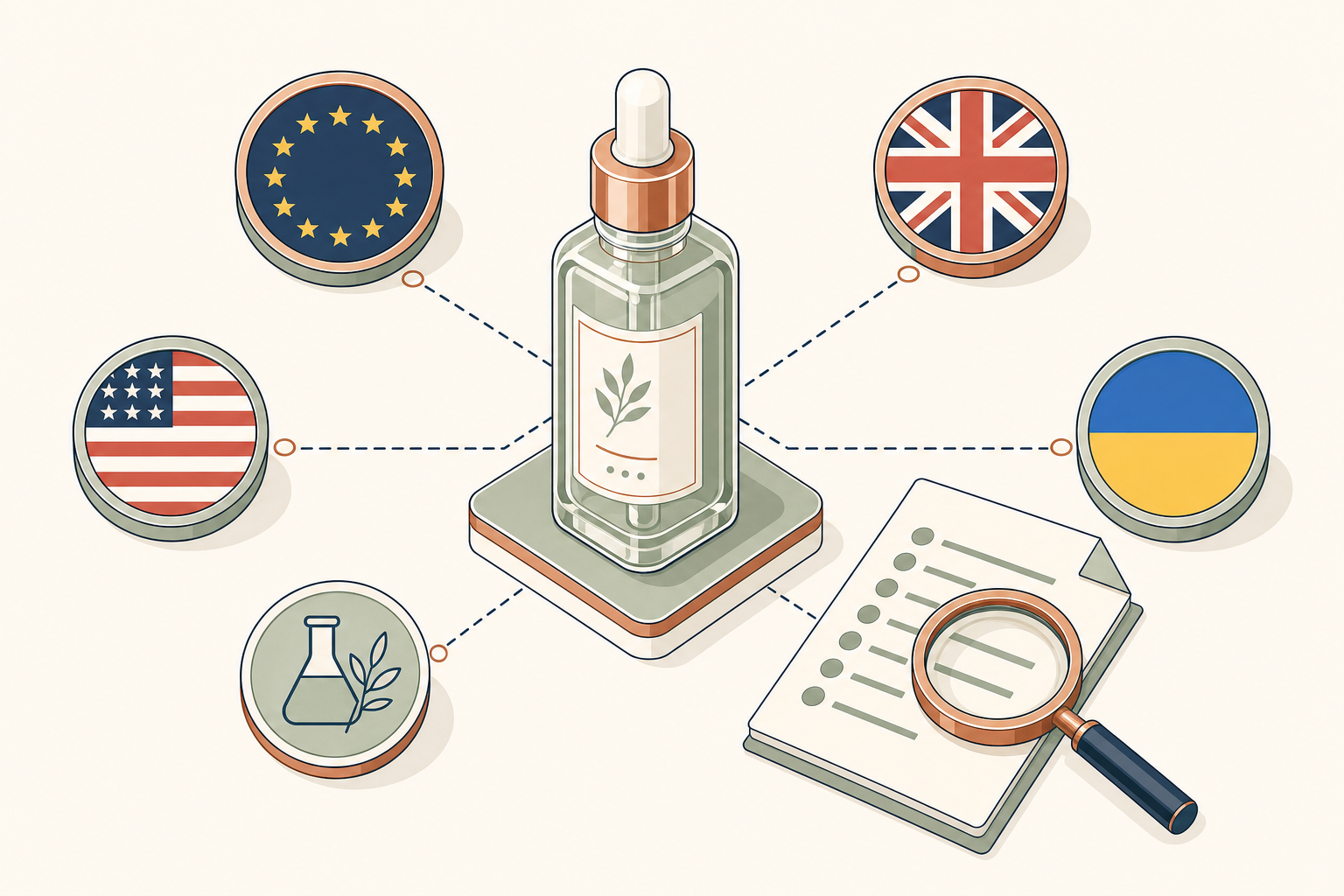

# CPSR 2026: What it is, who needs it and how to prepare it correctly
2026 has become a genuine turning point on the EU regulatory map: the 12th revision of the SCCS Notes of Guidance has taken effect, Omnibus VII and Omnibus VIII have come into force with bans on new CMR substances, and 31 July 2026 became the deadline for mandatory disclosure of 56 new fragrance allergens. For any manufacturer that is planning or already running sales in the European Union, the Cosmetic Product Safety Report is not merely a document in a folder but a living system that must be updated continuously.
> TL;DR: The CPSR (Cosmetic Product Safety Report) is a mandatory cosmetic product safety report compiled in accordance with Annex I to [Regulation (EC) No 1223/2009](https://eur-lex.europa.eu/legal-content/EN/TXT/?uri=CELEX:32009R1223). Without it, no product can be lawfully sold in the EU. Throughout 2025-2026, CPSR requirements have risen significantly because of new SCCS opinions, substance bans and an expanded list of allergens.
---
What the CPSR is and why it is needed
The Cosmetic Product Safety Report is a scientifically substantiated document that confirms that a given cosmetic product is safe for the consumer under normal or reasonably foreseeable conditions of use. It forms part of a larger documentation package — the Product Information File (PIF) — and is required by Article 10 and Annex I of [Regulation (EC) No 1223/2009](https://eur-lex.europa.eu/legal-content/EN/TXT/?uri=CELEX:32009R1223).
The legal logic is simple: unlike pharmaceuticals, cosmetics do not undergo any prior authorisation by regulators. Instead, responsibility for safety is placed entirely on the Responsible Person (RP) — the entity that places the product on the EU market. The CPSR is the means by which that responsibility is documented and demonstrated.
The practical significance of the CPSR extends well beyond formality. Firstly, without it, notification of the product in the [Cosmetic Products Notification Portal (CPNP)](https://single-market-economy.ec.europa.eu/sectors/cosmetic-product-notification-portal_en) is impossible — and this is a mandatory step before any sales in the EU. Secondly, in the event of an incident or market surveillance action, a weak or outdated CPSR provides grounds for withdrawing the product from the market.
A critical statistic: according to [MySwissLab](https://myswisslab.com/cpsr-requirements-guide-2025/), around 23% of CPSRs fail review on the first attempt because of insufficient scientific justification — most often due to an under-qualified Safety Assessor or omission of mandatory tests. This figure shows that the problem is not theoretical.
Who needs a CPSR? Any entity that: - manufactures cosmetics and places them on the EU market; - imports cosmetic products into the EU from third countries (including Ukraine); - acts as an authorised representative of a manufacturer in the EU; - distributes products under its own private-label brand.
---
CPSR structure: Part A and Part B in detail
The CPSR consists of two inseparable parts which together form a complete picture of product safety.
### What goes into Part A
Part A is the descriptive, factual section. It documents all the input data on the basis of which a safety conclusion can be drawn. In accordance with [Annex I to Regulation (EC) No 1223/2009](https://eur-lex.europa.eu/legal-content/EN/TXT/?uri=CELEX:32009R1223), Part A includes:
- Quantitative and qualitative composition of the product: a complete list of ingredients with concentrations, INCI names and functions. For fragrance compositions, an additional supplier declaration disclosing allergens is required.
- Physico-chemical characteristics: colour, pH, viscosity, form, particle size distribution (mandatory for nanomaterials).
- Microbiological quality: results of the Challenge Test (Preservative Efficacy Test, PET) confirming the effectiveness of the preservative system, together with data on microbial load (TVC, yeasts, moulds, specific pathogens).
- Stability testing: results of real-time storage and/or accelerated tests (at 45 degrees C or under freeze-thaw conditions) to substantiate shelf life and Period After Opening (PAO).
- Ingredient purity and raw-material specifications: supplier documentation, Certificate of Analysis (CoA), data on heavy metals, solvent residues and microbiological parameters.
- Data on nanomaterials: where nanoforms are present in the composition — particle size, shape and toxicological profile in accordance with the [2nd Revision of Guidance on Safety Assessment of Nanomaterials in Cosmetics](https://health.ec.europa.eu/scientific-committees/scientific-committee-consumer-safety-sccs_en).
- Justification of the preservative system: confirmation of effectiveness based on tests and concentrations.
- Toxicological profile of ingredients: NOAEL data, LD50, skin irritation, sensitisation, mutagenicity and reproductive toxicity for each significant component.
- Exposure data (exposure assessment): calculation of Systemic Exposure Dose (SED) for leave-on and rinse-off products, taking the retention factor into account.
### What goes into Part B
Part B is the safety assessment itself and the conclusion of a qualified Safety Assessor. It is this section that gives the entire document its legal force, since it contains the personal signature and contact details of the specialist responsible for the conclusion. Part B includes:
- An overall product safety assessment: whether the product is safe for humans under foreseeable conditions of use.
- Margin of Safety (MoS): a numerical indicator comparing the NOAEL with the calculated SED. An acceptable MoS is 100 or higher.
- An uncertainty assessment: comments on the quality of input data, gaps in the studies and conservative assumptions that have been applied.
- Statement of conditions of use: where safety is achieved only under specific restrictions (for example, consumer age, frequency of use, rinse-off or leave-on character), these are recorded here.
- Assessor qualifications: name, profession, qualification documents and compliance with the requirements of Article 10(2) of Regulation 1223/2009.
- Signature and date.
| Element | Part A | Part B | |---|---|---| | Composition and concentrations | Yes | - | | Test results (micro, stability, PET) | Yes | - | | Toxicological profiles of ingredients | Yes | - | | Exposure assessment / SED | Yes | - | | Nanomaterials | Yes | Yes | | Margin of Safety | - | Yes | | Safety conclusion | - | Yes | | Signature of qualified assessor | - | Yes |
---
SCCS 12th Revision 2025: what has changed
The [Scientific Committee on Consumer Safety (SCCS)](https://health.ec.europa.eu/scientific-committees/scientific-committee-consumer-safety-sccs_en) is an independent scientific body of the European Commission that issues Opinions on the safety of cosmetic ingredients that must be taken into account. Its Notes of Guidance set the standard with which a CPSR must comply.
The 12th revision of the Notes of Guidance, published in 2025, has materially tightened requirements in several areas:
Assessment for children and vulnerable groups. The SCCS now requires a separate exposure calculation for children (0-3 years, 0.5-10 years) using a paediatric retention factor together with appropriate body surface area and mass data. This is particularly critical for products used for childcare or applied in a domestic environment where children may come into contact with them.
Aggregated exposure assessment. The new standard provides that the Safety Assessor must take into account the cumulative exposure to the same ingredient from different products used at the same time. For example, where a preservative is present both in a face cream and a body product, both exposure sources must be summed.
Evidence-based approach to toxicology. The SCCS now accepts Read-Across and QSAR methods only where the structural similarity is justified in detail. A simple reference to an "analogous ingredient" is no longer sufficient.
Nanomaterials. The 2nd revision of the Guidance on Nanomaterials (published in parallel) requires an extended dossier: particle size distribution, solubility, agglomeration potential and data on the kinetics of skin absorption and inhalation toxicity for sprays.
Fragrance allergens. Following [Commission Regulation (EU) 2023/1545](https://eur-lex.europa.eu/legal-content/EN/TXT/?uri=CELEX:32023R1545), the CPSR must now contain complete quantitative information for all 82 regulated allergens, not only those above the threshold level.
The practical consequence: any CPSR drafted before 2024 almost certainly fails to comply with the current 12th-revision standard. According to [coslaw.eu](https://coslaw.eu/fragrance-allergens-july-eu-deadline-faq/), any CPSR more than three years old effectively requires a mandatory update — not only owing to the passage of time, but because of the pace of regulatory change.
---
New restrictions 2025-2026: parabens, salicylic acid, 56 allergens
Three regulatory waves in 2025-2026 directly affect the content of the CPSR.
### Butylparaben and salicylic acid: SCCS opinions of May 2025
On 2 May 2025 the SCCS published [Opinion SCCS/1674/25](https://health.ec.europa.eu/scientific-committees/scientific-committee-consumer-safety-sccs_en) on butylparaben. The conclusion is straightforward: butylparaben is not safe for children from 6 months to 10 years of age at a concentration of 0.14% in leave-on products under conditions of combined exposure from several products simultaneously. The safe concentration for this age group is no more than 0.002% in leave-on products and 0.092% in oral products.
On the same day, [Opinion SCCS/1675/25](https://health.ec.europa.eu/scientific-committees/scientific-committee-consumer-safety-sccs_en) was published on methyl salicylate, and a separate Opinion concerns salicylic acid as a preservative: at a concentration of 0.5% it is not safe under conditions of combined use; the recommended limit for dermal products intended for children is 0.1%.
The regulatory amendments to the Annexes are still in the process of being adopted, but Safety Assessors are already required to take the new scientific data into account in Part B. Any CPSR that justifies the safety of butylparaben or salicylic acid by reference to earlier standards needs to be revised.
### Omnibus VII (from 1 September 2025) and Omnibus VIII (from 1 May 2026)
[Commission Regulation (EU) 2025/877 (Omnibus VII)](https://eur-lex.europa.eu/legal-content/EN/TXT/?uri=CELEX:32025R0877) came into force on 1 September 2025. Among 22 new prohibitions, the most practically significant is the full ban on Trimethylbenzoyl Diphenylphosphine Oxide (TPO), a photoinitiator widely used in gel polishes and UV systems. According to [the analysis by coslaw.eu](https://coslaw.eu/new-substances-will-be-banned-in-cosmetics-in-the-eu-from-1-september-2025-omnibus-act-vii/), for products containing TPO, updating CPSR Part A (composition) and Part B (assessment) has become mandatory.
[Commission Regulation (EU) 2026/78 (Omnibus VIII)](https://eur-lex.europa.eu/legal-content/EN/TXT/?uri=CELEX:32026R0078), which started to apply on 1 May 2026, bans, among other things, silver in nano-form (diameter 1-100 nm) as a Category 2 CMR substance. Products containing silver in any form require a full CPSR revision, as noted by [the GPC Gateway analysis](https://gpcgateway.com/news/detail/eu-adopts-new-cmr-related-amendments-to-the-cosmetics-regulation/MjMyNg==).
### 56 new fragrance allergens from 31 July 2026
[Commission Regulation (EU) 2023/1545](https://eur-lex.europa.eu/legal-content/EN/TXT/?uri=CELEX:32023R1545) has expanded the list of fragrance allergens that must be declared from 26 to 82. From 31 July 2026, all new batches placed on the EU market must carry a complete list of allergens on the packaging where the concentration in leave-on products exceeds 0.001% and in rinse-off products 0.01%.
Labelling, however, is only the visible part. For the CPSR, this means a mandatory update of the safety assessment section: the assessor must evaluate the sensitisation potential of all 82 allergens, their concentrations in the finished product and the cumulative risk to the consumer. According to [Obelis Group](https://www.obelis.net/news/eu-cosmetics-fragrance-allergens-requirements/), the first step is to obtain from the fragrance composition supplier an updated declaration covering all 82 allergens with quantitative data and an IFRA Certificate.
---
UA CPSR vs EU CPSR: what is common, what needs further work
For a Ukrainian manufacturer that has already completed the path to UA compliance there is good news: the requirements of the Technical Regulation (TR) and EU Regulation 1223/2009 have far more in common than they differ. [CMU Resolution No. 65 of 20 January 2021](https://zakon.rada.gov.ua/laws/show/65-2021-%D0%BF) is built as the closest possible copy of the EU regulation — as confirmed by both [Cratia](https://cratia.ua/en/service/technical-regulation-on-cosmetic-products/) and [EcoMundo](https://ecomundo.eu/en/blog/ukraine-regualtion-cosmetics-eu).
A manufacturer that has properly prepared a PIF and CPSR for the Ukrainian market is, on VRC Cosmetics market research estimates, around 70-80% ready for EU compliance. What is already in place and what still needs to be done:
| Element | UA TR (in place) | EU CPSR (what to add) | |---|---|---| | Qualitative/quantitative composition (INCI) | Yes | Check alignment with the updated INCI Glossary (EU 2025/1175, 30,418 entries) | | Physico-chemical characteristics | Yes | - | | Microbiology + PET | Yes | - | | Stability | Yes | Confirm alignment with SCCS recommendations | | Toxicological profile | Partial | Full profile under SCCS 12th revision (aggregated dose, paediatric calculation) | | Margin of Safety (MoS) | Rarely | Must be calculated for every ingredient | | Signature of EU-qualified assessor | No | Mandatory signature by a person with qualifications recognised in the EU | | SED calculation under EU conditions | Partial | Recalculate using EU exposure factors | | 82 fragrance allergens (quantitative) | No | Full disclosure with concentrations | | Document language | Ukr./Eng. | English + no references to UA-specific norms | | Notification | MoH portal | Separate notification in the CPNP through an EU Responsible Person |
The key difference is not technical but legal: the CPSR for the EU market is signed by a Safety Assessor whose qualifications are recognised in one of the EU Member States. A UA-compliant person — even a qualified cosmetics technologist — cannot sign an EU CPSR unless their qualifications are confirmed by the relevant state authority of an EU Member State.
It is also worth noting that the Ukrainian Technical Regulation has not yet incorporated all post-regulation EU changes — in particular Omnibus VII, Omnibus VIII and the new allergen restrictions. For this reason, when preparing an EU CPSR you must rely on the current state of the EU Annexes, not on their UA equivalents. For details on Ukraine's 2026 Technical Regulation, see [Ukraine Cosmetics Technical Regulation 2026](/news/tekhnichnyy-rehulament-kosmetyky-ukraina-2026).
---
Who can sign a CPSR: qualification requirements
Article 10(2) of [Regulation (EC) No 1223/2009](https://eur-lex.europa.eu/legal-content/EN/TXT/?uri=CELEX:32009R1223) clearly defines the minimum qualifications of a Safety Assessor:
- a diploma in pharmacy, toxicology, medicine, dermatology or related disciplines;
- OR another higher-education diploma in the natural sciences that includes training in ingredient safety and risk assessment.
The qualification must be recognised in at least one EU Member State. In practice this means a diploma from an EU-accredited university or a confirmed document recognising the equivalence of the qualification.
In practice, most CPSRs are signed by: - Independent toxicologists (freelance Safety Assessors) — who can be engaged for a specific product. - In-house Safety Assessors at large manufacturers or contract laboratories. - Regulatory consultants who hold the relevant qualifications and specialise in EU cosmetics compliance.
Important: the person who carries out the analysis and prepares Part A need not have the same qualification as the person who signs Part B. Often a regulatory consultant or laboratory prepares Part A, while a qualified assessor reviews and signs Part B.
A typical CPSR error is a signature by someone who, while holding an education in the natural sciences, cannot document the precise qualification required by the regulation. This explains a significant share of the 23% of rejected CPSRs reported by [MySwissLab](https://myswisslab.com/cpsr-requirements-guide-2025/).
---
Cost and timing: approx. $800-3,000 per SKU
The cost of a CPSR depends on the complexity of the formulation, the product category, whether test data is already available and where exactly the service is commissioned. According to the [Sindebella EU Compliance Guide](https://sindebella.com/pages/eu-cosmetic-compliance-guide-costs-responsibilities-strategies) and [MySwissLab](https://myswisslab.com/cpsr-requirements-guide-2025/), the indicative range is:
| Scenario | CPSR cost (USD) | Timing | |---|---|---| | Standard formulation (rinse-off), all tests already in place | approx. $800-1,500 | 2-4 weeks | | Complex formulation (leave-on, actives) | approx. $1,500-2,500 | 4-8 weeks | | Product with nanomaterials or SPF | approx. $2,500-3,000+ | 6-12 weeks | | Update of an existing CPSR (minor change) | approx. $400-800 | 1-3 weeks |
These figures refer to the CPSR itself — the Part A+B document with the assessor's signature. They do not include the cost of laboratory testing, which can significantly increase the overall budget:
- Microbiology + PET: approx. $500-1,200
- Stability (accelerated): approx. $600-1,500
- Heavy metals testing: approx. $200-400
- SPF testing (where required): approx. $7,000-30,000
The total budget for EU compliance of a single SKU from scratch, including CPSR, laboratory tests and CPNP notification, comes to approx. $3,000-10,000. For products with an SPF claim it is $10,000 and up, as confirmed by [VRC Cosmetics UA market research](https://vrccosmetics.com/research).
Three factors that reduce cost: 1. Preparing a complete PIF (with all tests and documentation) before beginning work with the assessor — minimises the time spent on queries and clarifications. 2. Bundled submission: where a line consists of similar formulations (for example, a series of creams with different fragrances), part of the work can be done once. 3. Partnership with a regulatory consultant: saves time on finding a qualified assessor and ensures compliance with the SCCS 12th revision.
A complete guide to product notification once the CPSR is finalised is given in [CPNP notification 2026: step-by-step guide](/news/cpnp-notyfikatsia-2026-pokrokovyi-haid).
---
A step-by-step plan: from formulation to signed CPSR
Below is a practical algorithm for preparing a CPSR for a manufacturer entering the EU market or updating existing documentation.
Step 1. Formulation audit (2-4 weeks)
Check every ingredient against the current EU Annexes II, III, V and VI. Pay particular attention to the changes brought in by Omnibus VII (from 1 September 2025) and Omnibus VIII (from 1 May 2026). Check for the presence of nanomaterials. Obtain an updated declaration from the fragrance composition supplier covering all 82 allergens. Where ingredients are covered by new SCCS Opinions (butylparaben, salicylic acid, methyl salicylate), determine the concentrations and the target consumer age group.
Step 2. Collection of test data (4-12 weeks)
Commission, or confirm the existence of, the following: a microbiological test plus PET; a stability test (ideally real-time over 12-24 months, or accelerated); analysis for heavy metals; a CoA for every ingredient. For nanomaterials, separate testing under the SCCS Nanomaterials Guidance protocols is required. For SPF products, an in vivo or in vitro SPF test is needed.
Step 3. Preparation of Part A (2-4 weeks)
On the basis of the collected data, a regulatory specialist or consultant structures Part A: completing all the mandatory sections under Annex I and the updated 12th revision of the SCCS, calculating SED for each condition of use and filling in the toxicological profiles.
Step 4. Safety Assessor review and signing of Part B (2-6 weeks)
A qualified EU Safety Assessor receives the full Part A, reviews the justifications, calculates the MoS, identifies gaps and inconsistencies, formulates a conclusion and signs Part B. Where there are questions, one or two rounds of clarification may be required.
Step 5. The finalised CPSR — notification and retention
The signed CPSR becomes part of the PIF. The EU Responsible Person notifies the product in the [CPNP](https://single-market-economy.ec.europa.eu/sectors/cosmetic-product-notification-portal_en). The PIF must be kept for 10 years after the last batch of the product has been placed on the market. In parallel, the labelling must be checked for compliance with language requirements and the new allergen requirements. For more on labelling, see [Cosmetics labelling EU/UK/US/Ukraine 2026](/news/markuvannya-kosmetyky-eu-uk-us-ukraina-2026).
Step 6. Updating the CPSR when changes occur
The CPSR must be updated whenever there is any change in the formulation, in a supplier of a key ingredient, in the target audience or in the intended use of the product. An automatic trigger is the publication of a new SCCS Opinion concerning any ingredient in the composition.
---
Questions and answers
Is a CPSR needed if the product is already sold in Ukraine with a Ukrainian PIF?
Yes. Even though the UA Technical Regulation is structurally similar to EU Regulation 1223/2009, the CPSR for the EU market must be signed by a Safety Assessor whose qualifications are recognised in one of the EU Member States. A UA CPSR is not legally equivalent to an EU CPSR — but a significant proportion of the data collected can be reused, which reduces cost and timing.
How often does a CPSR need to be updated?
A CPSR more than three years old effectively requires review given the pace of regulatory change, as confirmed by [coslaw.eu](https://coslaw.eu/fragrance-allergens-july-eu-deadline-faq/). A mandatory update is triggered by a change in formulation, supplier or target audience, or by the publication of new SCCS Opinions and new prohibitions or restrictions affecting ingredients of the product.
What happens if a CPSR is missing or does not meet the requirements?
The product cannot legally be placed on the EU market. Where this is detected during market surveillance, the product is withdrawn, batches are recalled, and administrative sanctions and fines are imposed in accordance with the law of the Member State concerned. There are also reputational risks for the brand.
Is a single CPSR valid for several EU markets?
Yes. A CPSR drawn up in accordance with EU Regulation 1223/2009 is valid for all EU Member States — no separate documents are required for individual countries. Separate documents are required for the UK market (a UK CPSR with a UK-qualified assessor) and the US market (a substantiation package under MoCRA).
Do the new allergen rules affect products that have already been notified?
Yes. From 31 July 2026, all new batches placed on the EU market must carry updated labelling and a corresponding CPSR. Products already in circulation with the old labelling may continue to be sold until 31 July 2028. However, where a CPSR does not reflect the full picture of the 82 allergens, it needs to be updated now.
---
Ready to prepare your CPSR properly?
VRC Cosmetics supports cosmetics manufacturers at every stage of EU compliance — from formulation audit to a signed CPSR and CPNP notification. We work with qualified EU Safety Assessors, know which mistakes to avoid and help you convert your UA documentation into EU-ready form.
If you already have a UA PIF, you have a head start. Let us work out together what specifically needs to be done for your product.
[Fill in the consultation form](https://vrccosmetics.com/contact) or [order CPSR preparation](https://vrccosmetics.com/services/cpsr) — and we will get back to you within one business day.
Author
VRC Cosmetics
Regulatory Expert
VRC Cosmetics is a regulatory consulting firm for cosmetics manufacturers with 10+ years of experience in EU, UK and US compliance.