
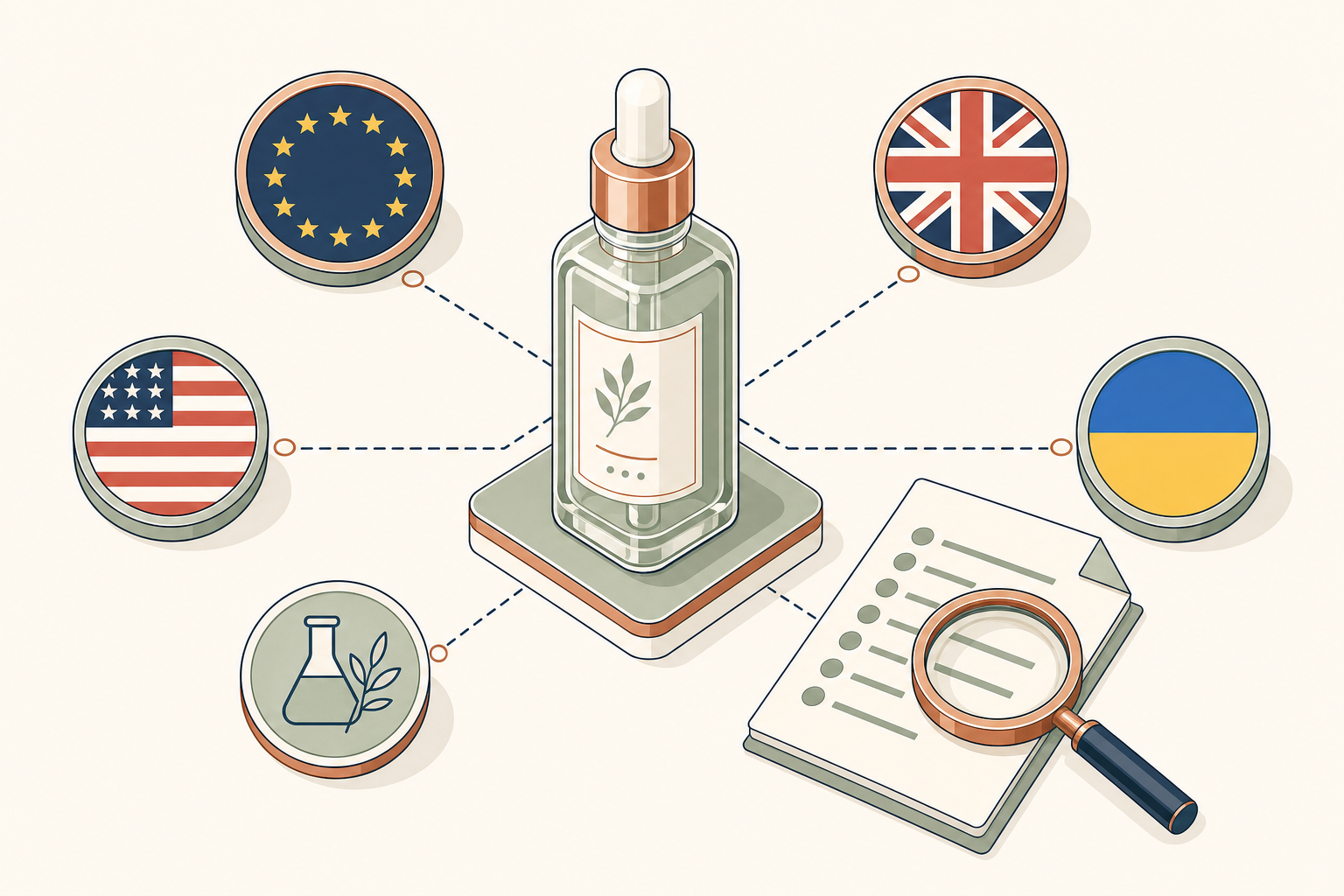
# Cosmetics Labelling 2026: EU vs UK vs US vs Ukraine — the complete comparison table
Labelling a cosmetic product is not simply a list of ingredients. It is a legal document on the pack, where every word, symbol and language has a regulatory basis. In 2026, four markets are simultaneously updating or bringing into force key requirements: the EU expands the allergen list to 82 substances, the UK introduces a lower threshold for formaldehyde, the US completes the roll-out of MoCRA, and Ukraine moves to mandatory e-notification through the Ministry of Health portal.
If your brand sells products in more than one of these markets, read on: this article is the single Ukrainian-language resource that brings all four systems together in one place.
> Short answer: the EU and the UK have the strictest INCI and allergen requirements; the US permits alternative nomenclature; Ukraine requires the state language and a graphic pack file for the Ministry of Health. No market accepts labelling prepared solely for another.
---
Minimum mandatory information on the pack: 4 markets in one table
The first step in preparing labelling is understanding which elements are mandatory in each market. Below is a summary table based on [Regulation (EC) No 1223/2009](https://eur-lex.europa.eu/legal-content/EN/TXT/?uri=CELEX:32009R1223), the [UK Cosmetics Regulation (retained EU law)](https://www.russellregulatoryconsultants.com/2025/06/17/uk-cosmetics-regulation-an-introduction-for-new-brands/), [MoCRA (US)](https://www.fda.gov/cosmetics/cosmetics-laws-regulations/modernization-cosmetics-regulation-act-2022-mocra) and the [UA Technical Regulation, CMU Resolution No. 65](https://zakon.rada.gov.ua/laws/show/65-2021-%D0%BF).
| Labelling element | EU | UK | US (MoCRA) | Ukraine | |---|---|---|---|---| | Product name | Mandatory | Mandatory | Mandatory | Mandatory (in Ukrainian) | | Name and address of the responsible person | EU RP, EU address | UK RP, UK address | US Responsible Person / contact | Ukrainian resident | | Nominal content (mass / volume) | Mandatory | Mandatory | Mandatory | Mandatory | | Date of minimum durability / PAO | If <30 months — date; if >30 months — PAO | Same as EU | Not federally regulated | Same as EU | | Special warnings | Mandatory (Annex III) | Same as EU | Mandatory where risk is present | Mandatory | | Batch number (batch code) | Mandatory | Mandatory | Mandatory (MoCRA) | Mandatory | | List of ingredients | INCI, in descending order | INCI, in descending order | In descending order (INCI not mandatory) | INCI, in descending order | | Country of origin | If outside the EU — mandatory | "Made in [country]" mandatory | Mandatory | Mandatory | | Product function | If not obvious | If not obvious | If not obvious | If not obvious | | Consumer contact information | Within RP details | Same as EU | Telephone or email (AER obligation) | Within RP details |
Key difference: the UK requires a specific country of manufacture to be stated (for example, "Made in Ukraine"), whereas "Made in EU" is legally incorrect on the British market after Brexit, according to [Russell Regulatory Consultants](https://www.russellregulatoryconsultants.com/2025/06/17/uk-cosmetics-regulation-an-introduction-for-new-brands/). The US, under MoCRA, has introduced an obligation to provide a contact address, telephone number or email for reports of serious adverse events.
---
Language of labelling: what the EU, UK, US and Ukraine require
Language requirements are one of the most common reasons for goods being held at customs or refused registration. Each market has its own rules.
EU. [Regulation (EC) No 1223/2009, Article 19](https://eur-lex.europa.eu/legal-content/EN/TXT/?uri=CELEX:32009R1223) requires labelling to be in the language (or languages) of the country in which the product is made available. A brand selling simultaneously in Poland, the Czech Republic and France is required to have Polish, Czech and French texts, or multilingual labelling. There is no single official "EU language" for cosmetics.
UK. Following Brexit, the requirements are similar: labelling must be in English. The PIF (Product Information File) must also be entirely in English, according to [GOV.UK guidance](https://www.gov.uk/guidance/submit-a-cosmetic-product-notification).
US (MoCRA). There are no federal requirements for a specific language for consumer labelling under FDA legislation. In practice, however, English is the standard, and any safety-related warning must be intelligible to the target consumer.
Ukraine. [CMU Resolution No. 65 of 20 January 2021](https://zakon.rada.gov.ua/laws/show/65-2021-%D0%BF) and the Law "On Ensuring the Functioning of the Ukrainian Language as the State Language" (Article 13) provide that all mandatory information on the label must be stated in the state language — Ukrainian. The simultaneous use of other languages is permitted, but the Ukrainian text is mandatory rather than duplicative. A sticker solution is technically permitted: the labelling may be applied as a sticker, insert, tag or card, without necessarily reprinting the pack.
| Labelling language aspect | EU | UK | US | UA | |---|---|---|---|---| | Mandatory language | Language of the country of sale | English | Not specified | Ukrainian | | Sticker instead of a reprint | Permitted | Permitted | Permitted | Permitted (CMU No. 65) | | PIF/CPSR language | No requirement (in practice — EN) | English | No formal requirement | Ukrainian (or EN + translation) | | Language of the e-notification form | None (CPNP — EN/FR) | None (SCPN — EN) | None (Cosmetics Direct — EN) | Ukrainian (Ministry of Health portal) |
---
INCI: the difference between EU nomenclature and FDA ingredient names
The ingredient list is the most visible part of the label, yet this is where the largest divergences between markets arise.
EU and UK. Both markets require the use of [INCI (International Nomenclature of Cosmetic Ingredients)](https://ec.europa.eu/growth/tools-databases/cosing/) — the international nomenclature maintained by the Personal Care Products Council (PCPC). From 30 July 2026, the updated glossary becomes mandatory: [Implementing Decision (EU) 2025/1175](https://cosmeservice.com/news/eu-regulatory-developments-transforming-cosmetic-compliance-in-2025-and-beyond/) has added 348 new names, bringing the total of the EU INCI Glossary to 30,418 entries. If an ingredient has a new name in the glossary, the previous designation will no longer comply with the requirements on new batches after 30 July 2026.
US (MoCRA). The FDA does not strictly require INCI. The use of USAN (United States Adopted Names), CTFA (Cosmetic, Toiletry and Fragrance Association) names or commonly used chemical names is permitted. In practice most large manufacturers use INCI, but this is not mandatory for small brands. The list must be in descending order of concentration.
Practical difference. The same ingredient may be named differently. For example:
| Ingredient | INCI (EU/UK) | USAN/CTFA (USA) | |---|---|---| | Glycerol | Glycerin | Glycerol or Glycerin | | Propylene glycol | Propylene Glycol | Propylene Glycol | | Retinol | Retinol | Retinol (identical) | | Jojoba oil | Simmondsia Chinensis (Jojoba) Seed Oil | Jojoba Oil | | Allantoin | Allantoin | Allantoin (identical) | | Citric acid | Citric Acid | Citric Acid (identical) |
For nanomaterials, the EU requires "(nano)" to be added after the INCI name directly in the ingredient list — for example, "Titanium Dioxide (nano)". This requirement appears in both EU Regulation 1223/2009 and the UK Cosmetics Regulation, but is absent from MoCRA.
---
82 allergens in EU labelling from 31 July 2026: the complete list of thresholds
This is the most significant change to labelling in the last two decades. Since 1999, the EU has required the declaration of 26 fragrance allergens. [Regulation (EU) 2023/1545 of 26 July 2023](https://eur-lex.europa.eu/legal-content/EN/TXT/?uri=CELEX:32023R1545) has extended the list by a further 56 substances — bringing the total to 82 allergens that must be individually declared on the pack.
Threshold concentrations for mandatory declaration:
| Product type | Declaration threshold | |---|---| | Leave-on products (creams, lotions, perfumes) | above 0.001% in the finished product | | Rinse-off products (shampoos, shower gels) | above 0.01% in the finished product |
Among the new 56 allergens that take effect on 31 July 2026 are components of natural essential oils, terpenes and isomers that were previously permitted without declaration: Atranol, Chloroatranol, Myroxylon Pereirae Resin (Peru Balsam), Evernia Prunastri (Oakmoss) at higher concentrations, numerous citral isomers, Farnesol, Lilial, Lyral and others. The full list is set out in the text of [Regulation (EU) 2023/1545](https://eur-lex.europa.eu/legal-content/EN/TXT/?uri=CELEX:32023R1545) (Annex III).
Practical action: ask your fragrance supplier for an updated declaration listing all 82 regulated allergens together with their concentrations in the finished product. If a concentration exceeds the threshold, the allergen is listed in the ingredient list under its INCI name, outside the general entry "Parfum" or "Aroma".
According to the [Obelis Group](https://www.obelis.net/news/eu-cosmetics-fragrance-allergens-requirements/), any new batch of product that crosses the EU customs border after 31 July 2026 is treated as a new placing on the market — even if the product is already registered in CPNP. Non-compliant batches may be detained, returned or destroyed.
### New-batch deadline vs sell-through of existing stock until 31 July 2028
The regulation distinguishes between two horizons:
- New batches (manufactured and placed on the EU market after 31 July 2026): must carry full labelling with the 82 allergens
- Existing stock (products already on shelves or in the logistics chain as of 31 July 2026): may be sold through until 31 July 2028 without updating the labelling
This means: if your warehouse or distributor in the EU holds residual stock with the old labelling on 31 July 2026, it does not automatically become illegal. However, any new shipment from the manufacturer — even with the same SKU — must already comply with the new requirements. According to [coslaw.eu](https://coslaw.eu/fragrance-allergens-july-eu-deadline-faq/), a CPSR more than 3 years old must be updated to take account of the new allergens — this is also a trigger to review the documentation.
---
UK divergence 2026: formaldehyde, kojic acid, BHT
Following Brexit, the UK updates its own lists of restrictions independently of the EU. This creates a situation in which an EU-compliant product may breach UK requirements — and vice versa. [UK Statutory Instrument 2026/23](https://www.mishcon.com/news/uk-and-eu-cosmetics-regulations-what-beauty-businesses-need-to-know-about-2026-updates-to-the-law), published in January 2026, introduces three substantive divergences.
Formaldehyde release. The threshold concentration above which the warning "releases formaldehyde" (instead of the former "contains formaldehyde") is required has been lowered from 0.05% to 0.001% with effect from 15 July 2026. This means that formaldehyde-donor preservatives (DMDM Hydantoin, Imidazolidinyl Urea, Diazolidinyl Urea, Quaternium-15 and others) will now require a warning on UK packs at almost any working concentration. In the EU, no comparable reduction in the threshold has so far taken place.
Kojic Acid. The UK has introduced a restriction: a maximum of 1% in face and hand products (from 20 June 2025, with transitional sell-through until 1 November 2025). As of mid-2026, the EU has no equivalent restriction in the Annexes to Regulation 1223/2009 — an example of active UK-specific restructuring. Products containing kojic acid for the EU market may be compliant, yet fail to meet UK requirements without reformulation.
BHT (Butylated Hydroxytoluene). The UK has banned BHT in all leave-on oral care products and introduced new concentration limits for toothpaste and mouthwashes. The EU permits BHT in these categories.
| Substance | UK regulation (2026) | EU status | UK deadline | |---|---|---|---| | Formaldehyde release (preservatives) | Warning threshold lowered to 0.001% | Threshold 0.05% (unchanged) | 15.07.2026 | | Kojic Acid | Max. 1% (face and hands) | No restrictions in force | Transitional sell-through until 01.11.2025 | | BHT | Banned in leave-on oral care | Permitted in oral care | In force from 2025–2026 | | 3-(4'-methylbenzylidene)-camphor | Banned | Already banned in the EU | 15.07.2026 |
Critical takeaway for manufacturers: EU-compliant labelling is not automatically UK-compliant. A separate compliance matrix is required for each market. According to [Russell Regulatory Consultants](https://www.russellregulatoryconsultants.com/2025/06/17/uk-cosmetics-regulation-an-introduction-for-new-brands/), even a CPSR signed by an EU assessor may not be recognised in the UK — a UK-qualified safety assessor is required.
---
UA: Ukrainian language + electronic labelling file for the Ministry of Health portal
Ukrainian labelling requirements are based on [CMU Resolution No. 65 of 20 January 2021](https://zakon.rada.gov.ua/laws/show/65-2021-%D0%BF) — a technical regulation that reproduces the logic of EU Regulation 1223/2009, but with several specifics of its own.
State language — no alternative. Article 13 of the Law "On Ensuring the Functioning of the State Language" provides that all mandatory consumer information — product name, composition, warnings, shelf life and the name of the responsible person — must be set out in Ukrainian. Other languages may appear in parallel, but not in place of Ukrainian. For imported products, a sticker solution is a common practice.
Electronic notification. From 1 December 2025, Ukraine launched a system of electronic notification of cosmetic products through the Ministry of Health portal — an analogue of the EU CPNP, in accordance with [Order of the Ministry of Health No. 2147 of 18 December 2023](https://www.theworldlawgroup.com/membership/news/news-ukraine-launched-e-notification-for-cosmetic-products). Deadline: by 3 August 2026 all products in circulation must be notified.
When notifying via the Ministry of Health portal, the manufacturer is required to submit a graphic file of the pack labelling — a scan or rendering of the front and back panels. This is a requirement not found in the EU CPNP: there, a photo of the pack is uploaded, but not a separate graphic file. The format and technical requirements for the file are set out by Order of the Ministry of Health.
| Requirement | EU (CPNP) | UK (SCPN) | US (Cosmetics Direct) | UA (Ministry of Health portal) | |---|---|---|---|---| | Pack photograph | Mandatory | Mandatory | Not required | Graphic file (mandatory) | | Language of the notification form | EN/FR | EN | EN | Ukrainian | | Notification deadline for a new product | Before placing on the market | Before placing on the market | Within 120 days | By 03.08.2026 (for current SKUs) | | Notification of nanomaterials | 6 months in advance (separate) | 6 months in advance (separate) | Not provided for | By analogy with the EU |
An important detail: the UA Technical Regulation is based on EU Regulation 1223/2009 as it stood in 2021 and does not automatically include later amendments — Omnibus VII/VIII, the allergen regulation, the 2025/1175 INCI Glossary. A manufacturer exporting to the EU is required to track EU amendments separately, regardless of an existing UA notification. More on the notification process is set out in [CPNP 2026: a step-by-step guide](/news/cpnp-notyfikatsia-2026-pokrokovyi-haid) and [Technical Regulation for Cosmetic Products of Ukraine 2026](/news/tekhnichnyy-rehulament-kosmetyky-ukraina-2026).
---
PAO, best-before, country of origin: rules across the markets
Three elements of labelling that most often raise questions when entering a new market.
Period After Opening (PAO) — the "open jar" symbol. EU and UK: if a product has a shelf life of more than 30 months, the PAO symbol is used together with the number of months indicated (for example, "12M"). If the shelf life is less than 30 months, a "best before" date (the "hourglass" symbol) is mandatory. US: the FDA imposes no federal requirement for a PAO or expiry date on most cosmetics. The exceptions are SPF products, antiperspirants and certain OTC drug products, where shelf life is regulated under Drug Regulation. Ukraine: by analogy with the EU — the same 30-month threshold.
Best-before date. For products with a shelf life of less than 30 months, the EU, UK and Ukraine require the format: "best before end: MM/YYYY" or a symbol with the date. US: not mandatory for the vast majority of cosmetics.
Country of origin. EU: stated if the product is manufactured outside the EU (for example, "Made in Ukraine"). For EU-manufactured products this is not mandatory, but is recommended. UK: a specific country of manufacture is mandatory — "Made in EU" is legally incorrect; "Made in France", "Made in Ukraine" and so on are required. US: "Country of origin" is mandatory for goods through US Customs (FTC Fair Packaging and Labeling Act). UA: stating the country of manufacture is mandatory.
| Element | EU | UK | US | UA | |---|---|---|---|---| | PAO (>30 months) | Symbol + figure | Symbol + figure | Not regulated | Symbol + figure | | Best-before (<30 months) | Mandatory | Mandatory | Not mandatory | Mandatory | | "Made in EU" | Permitted | Not permitted | Not applicable | Permitted | | Specific country | For non-EU | Always | Always | Always |
---
Checklist: 20 verification points before shipping to the EU
Use this checklist before dispatching a new batch of cosmetics to the EU market. Each point is a legal obligation of the responsible person under [Regulation (EC) No 1223/2009](https://eur-lex.europa.eu/legal-content/EN/TXT/?uri=CELEX:32009R1223).
Overall compliance:
1. An EU Responsible Person has been appointed (a legal or natural person registered in the EU). 2. The product has been notified through CPNP before its first placing on the market. 3. The PIF (Product Information File) is held by the EU RP for 10 years after the last batch. 4. The CPSR (Cosmetic Product Safety Report) is signed by a qualified safety assessor in line with the SCCS 12th Revision.
Formulation:
5. The formula has been checked for compliance with the current Annex II (prohibited substances), including Omnibus VII (from 01.09.2025) and Omnibus VIII (from 01.05.2026). 6. Restricted substances (Annex III) comply with the limits set for the product category. 7. Nanomaterials have been declared and notified in CPNP at least 6 months before market entry.
Ingredient labelling:
8. The INCI list complies with the current EU INCI Glossary (from 30.07.2026 — 30,418 names, [EU 2025/1175](https://cosmeservice.com/news/eu-regulatory-developments-transforming-cosmetic-compliance-in-2025-and-beyond/)). 9. Nanomaterials are marked with "(nano)" after the INCI name. 10. All 82 allergens have been checked: leave-on >0.001%; rinse-off >0.01% — each listed individually ([Regulation (EU) 2023/1545](https://eur-lex.europa.eu/legal-content/EN/TXT/?uri=CELEX:32023R1545)).
Pack labelling:
11. The name and address of the EU RP appear on the primary or secondary packaging. 12. The labelling language corresponds to the language(s) of the country (countries) of sale. 13. The country of manufacture is stated (for non-EU manufacturers). 14. The PAO symbol or best-before date is present, in line with the shelf life. 15. A batch code (batch number) is applied to the pack. 16. All mandatory warnings (Annex III) are present and clearly legible.
CPNP notification:
17. The notification is current: where the formulation, labelling or RP changes, CPNP has been updated. 18. A pack photograph has been uploaded to CPNP (front and back panels). 19. For products containing the new 56 allergens (where applicable): CPNP has been updated with the new ingredient list.
Packaging:
20. The packaging has been checked for compliance with [PPWR (EU) 2025/40](https://informait.com/news/ppwr-compliance-guide-2026): no PFAS in food-contact packaging (from 12.08.2026).
If you have any doubts about a particular point, seek advice from your EU Responsible Person or a regulatory consultant before shipping the batch. For more on preparing the CPSR and CPNP, see our article [CPSR 2026: the complete manufacturer's guide](/news/cpsr-2026-povnyi-haid-vyrobnyka).
---
FAQ
Can the same pack be used simultaneously for the EU and the UK?
Technically yes, but in practice very rarely without compromises. The UK requires the UK RP address, certain warnings may be worded differently (for example, the formaldehyde threshold), and kojic acid or BHT may be present in the formulation. The most common solution is multi-regional packaging with clear space for a sticker carrying UK-specific information.
Is it necessary to translate the entire INCI list for each EU country?
No. INCI is an international nomenclature and is not translated. Ingredient names remain in Latin regardless of the labelling language. The items requiring translation are: the product name, the description of function (where stated), warnings and instructions, and the name and address of the RP.
When does the new INCI Glossary with 30,418 names take effect?
From 30 July 2026, in accordance with [Implementing Decision (EU) 2025/1175](https://cosmeservice.com/news/eu-regulatory-developments-transforming-cosmetic-compliance-in-2025-and-beyond/). Until that date, the use of the previous INCI names is permitted; thereafter, new batches must use the current glossary.
Does UA notification with the Ministry of Health remove the obligation to notify in CPNP?
No. These are two independent systems. UA e-notification is designed for access to the Ukrainian market. EU CPNP is for access to the market of any EU country. They are parallel, not interchangeable. By the same logic, the UK SCPN is a third separate system for the British market.
Do the new 56 allergens apply to products without a fragrance composition?
In practice, no. If a product does not contain essential oils, fragrance compositions or aromatic components, none of the new allergens will be present at a relevant concentration. However, it is still worth checking all the ingredients (including plant extracts): some natural components contain allergenic terpenes by nature.
---
Need a label check before shipping to the EU?
VRC Cosmetics carries out labelling audits for cosmetic SKUs: a check for compliance with EU Regulation 1223/2009, the updated INCI Glossary, the 82 allergens and the PPWR. Commission a labelling audit for your SKUs before shipping to the EU — there is less time left until the 31 July 2026 deadline than it seems.
Also read on our blog: - [CPSR 2026: the complete manufacturer's guide](/news/cpsr-2026-povnyi-haid-vyrobnyka) - [CPNP notification 2026: a step-by-step guide](/news/cpnp-notyfikatsia-2026-pokrokovyi-haid) - [Technical Regulation for Cosmetic Products of Ukraine 2026](/news/tekhnichnyy-rehulament-kosmetyky-ukraina-2026)
---
```json { "slug": "markuvannya-kosmetyky-eu-uk-us-ukraina-2026", "title": "Cosmetics Labelling 2026: EU vs UK vs US vs Ukraine — the complete comparison table", "excerpt": "82 allergens in the EU, formaldehyde in the UK, MoCRA in the US and the Ukrainian-language requirement under CMU Resolution No. 65 — a complete comparative table of cosmetics labelling requirements across four markets in 2026.", "categorySlug": "regulatory-eu", "tags": ["Labelling", "INCI", "EU Regulation", "UK Cosmetics", "MoCRA", "2026"], "authorName": "VRC Cosmetics", "authorRole": "Regulatory expert", "authorBio": "The VRC Cosmetics team specialises in regulatory compliance for cosmetic brands entering the EU, UK, US and Ukrainian markets. We support manufacturers from CPSR to CPNP — with a practical understanding of each market.", "readingTime": 13 } ```
Author
VRC Cosmetics
Regulatory expert
The VRC Cosmetics team specialises in regulatory compliance for cosmetic brands entering the EU, UK, US and Ukrainian markets. We support manufacturers from CPSR to CPNP — with a practical understanding of each market.